🏠Home / 📁Physics / 📁Level 2 / 📁Mechanical phenomena / 📁Mechanical balance / 📁Mechanical equilibrium of the rigid solid / 📄Rotational balance
|
|
|
|
|||
|
🏠Home / 📁Physics / 📁Level 2 / 📁Mechanical phenomena / 📁Mechanical balance / 📁Mechanical equilibrium of the rigid solid / 📄Rotational balance
|
|||||
A rigid solid body is in rotational equilibrium if:
is at rest
or
rotates uniformly about an axis.
Moment of force is the determining factor of a rotational movement.
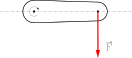
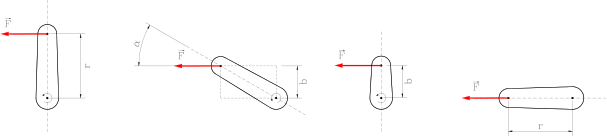
Consider a crank arm on which a force acts :
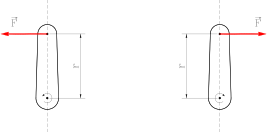
The effect is that this body will rotate. The further the force acts from the axis of rotation, the stronger the effect of rotation will be.
Moment of force is a physical vector quantity whose magnitude is defined by:
|
|
|
|
Unit of measure:
|
|
|
|
By convention:
M>0 if the rotation will be counter-clockwise;
M<0 if the rotation will be clockwise.
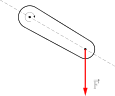
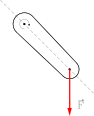
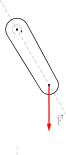
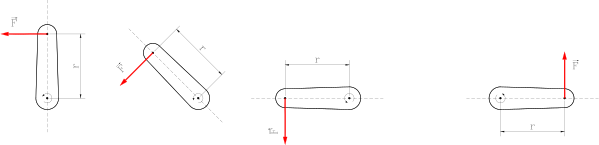
Different phases of the rotational movement, in which the same rotational moment acts on the body:
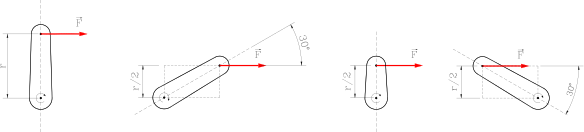
The magnitude of the moment of force also depends essentially on the direction of the force relative to the direction of the crank arm. If between these directions the angle is 30° then the moment of the force is halved:
In general, the moment of force is determined by the formula:
|
|
|
|
where b is the distance from the direction of the force to the axis of rotation and is called the arm of force, again α is the angle between the direction of the force and the direction joining the center of rotation and the point of application of the force.
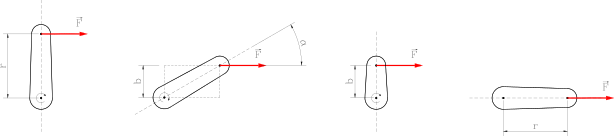
The moment of the force is maximum when α=90° and becomes 0 when α=0.
The necessary and sufficient condition of rotational balance is that the resultant moment of all forces is 0:
|
|
|
|
1. On a bicycle pedal having the length arm r=170mm a force of magnitude is applied F=300N, which keeps its direction unchanged during rotation. Determine the moment of force for different phases of rotation:
|
movement phase |
the arm of force |
moment of force |
|
|
|
|
|
|
|
|
|
|
|
|
|
|
|
|
|
|
|
|