🏠Home / 📁Physics / 📁Level 2 / 📁Mechanical phenomena / 📁Mechanical balance / 📁Mechanical equilibrium of the rigid solid / 📄Mechanical balance itself
|
|
|
|
|||
|
🏠Home / 📁Physics / 📁Level 2 / 📁Mechanical phenomena / 📁Mechanical balance / 📁Mechanical equilibrium of the rigid solid / 📄Mechanical balance itself
|
|||||
A rigid solid body is truly in equilibrium if it is simultaneously in translational and rotational equilibrium.
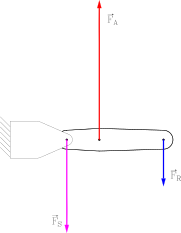
An example of application is leverage:
a) first-order leverage:
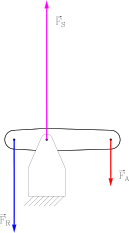
a variant of first-order leverage:
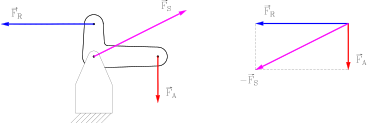
b) the second lever:
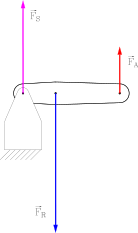
c) the lever of the 3rd orin:
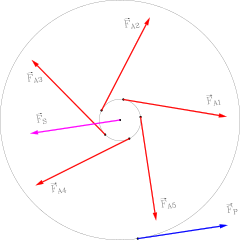
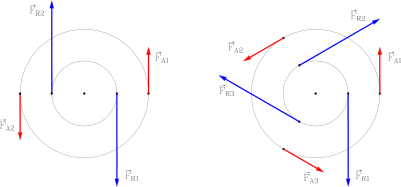
Another example: A coupling is made between two mechanical shafts by means of 2 and 3 clamping screws, respectively:
1. A car with mass m=1.6 tons climbs a 15% incline at constant speed. The wheels are of size R15 190 65: their diameter is 634mm, and the rims are fastened in 5 bolts evenly placed on a circle with a diameter of 110mm. We assume that the weight is distributed evenly on all wheels. What force does each screw apply? Displacement resistance forces are neglected.
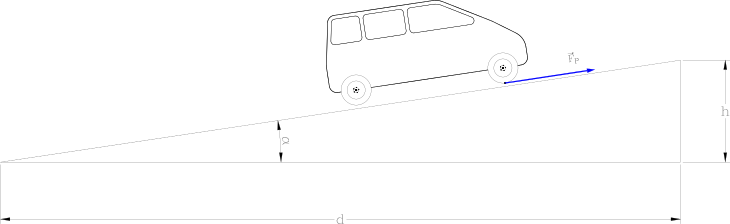
wheel detail: