|
|
|
|
|||
Electrostatics studies electric charges at rest and the interactions between them.
Electric charge is a fundamental property of matter that manifests itself through interactions that bear the general name of electromagnetic interactions.
Electric charge is a scalar physical quantity that in the international system has the unit of measurement: .
There are two kinds of electric charges: positive charges and negative charges (these notions were introduced by Benjamin Franklin).
Any body contains both types of charge. The normal state of a body is that of electrical neutrality, in which case the body contains equal amounts of positive and negative charges. If there is an imbalance between the two types of charges, the body is positively or negatively charged.
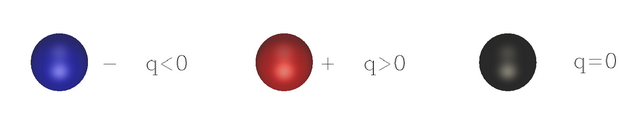
Convention: in the following drawings:
Bodies carrying a positive charge are drawn in red;
Negatively charged bodies are drawn in blue;
Bodies without electric charge are drawn in black.
This interaction occurs between electrically charged bodies at rest or moving at low speed.
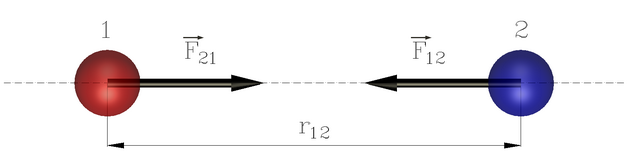
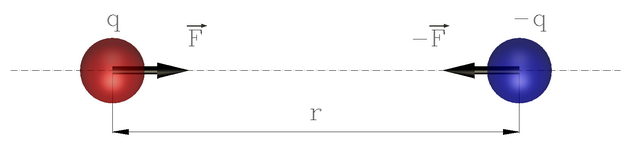
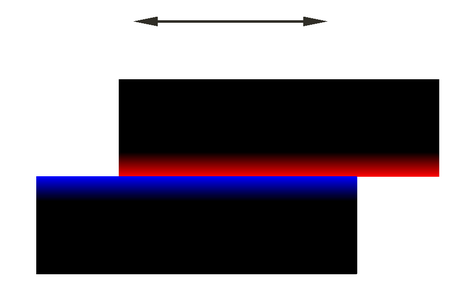
Bodies with opposite charges (one positively charged, the other negatively charged) attract:
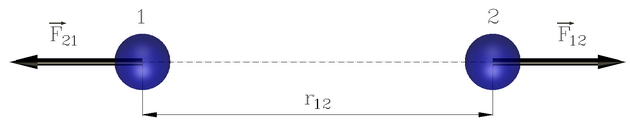
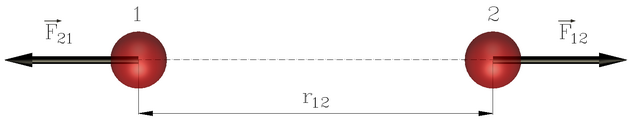
Bodies with electric charges of the same kind (both positive or both negative) repel:
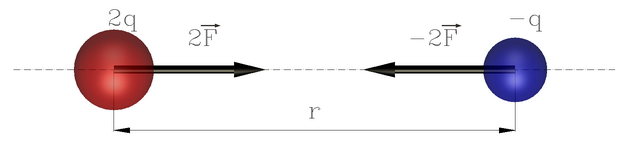
In the drawings above, two spherical objects numbered 1, 2 are considered. The distance between their centers is denoted by r12. With noted the force with which the second body acts on the first, which in turn reacts on the second with an equal and opposite force .
forces and form an action-reaction pair and in the case of a pair of electrically charged point or spherical objects, they have the following properties:
Their points of application are in the center of the spheres;
Their directions are along the line joining the two centers;
The magnitude of the attractive or repulsive forces depends on the distance between the bodies and the magnitudes of the charges;
The forces are doubled if the load on one of the bodies is doubled at the same distance:
The forces increase 4 times if the distance between the bodies is halved:
There is a mathematical expression of Coulomb's law:
|
|
|
(1) |
where k is a constant with a certain value: if the interaction takes place in vacuum.
Example: Two very small bodies (which we consider to be point-like) are at r=1m from each other. One is positively charged (q1=5C), and the other is negative (q2=-2C). The electrostatic interaction force is: . The result is negative: this means that the two bodies attract each other.
If both bodies are positive or negative, the result will be positive: the two bodies repel each other.
It should be noted that the obtained force value is extraordinarily high. It turns out that the 2C, 5C values of the electrical charges are actually extraordinarily large.
We reconsider the problem: the 2 objects have equal electrical charges (q1=q2=q), are at a distance of just r=1cm and forcefully repel each other F=10-3 N (as observed in electrostatics experiments). What are the magnitudes of electric charges?
|
|
|
|
This notion designates the smallest particles carrying an electric charge. These are components of atoms: the electrons (–) and the protons (+). There are also neutral elementary particles: neutrons, which also enter into the composition of atoms.
What size are these loads:
Electrons have negative charge qe=–1.6·10-19 C.
Protons have the same magnitude but positive charge: qp=1.6·10-19 C.
Although the charges are the same, the masses of protons and electrons differ greatly:
An electron weighs me=9.11·10-31 kg.
A proton weighs 1837 times more: mp=1.673·10-27 kg.
A neutron weighs about the same: mn=1.675·10-27 kg. It is only slightly heavier than a proton.
Atoms normally possess the same number of protons and electrons, so the total electric charge is 0. Atoms are neutral. But atoms can lose one or more electrons and become so positive ions. Atoms can also receive additional electrons and become so negative ions.
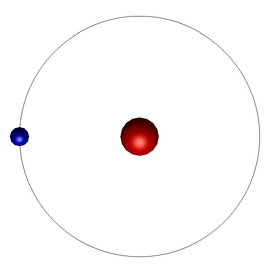
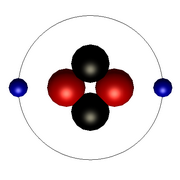
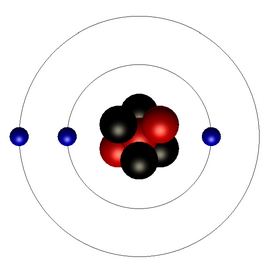
The simplest atom is the hydrogen atom: it consists of a proton and an electron orbiting the proton. The helium atom has a positive nucleus consisting of 2 protons and 2 neutrons, around which 2 electrons orbit. The lithium atom has a nucleus made up of 3 protons, 4 neutrons and 3 electrons orbit around it.
|
The hydrogen atom H |
Helium atom He |
The lithium atom Li |
A copper sphere with the diam d=1cm is in neutral electrical state. In fact it contains equal amounts of + and – charges. How big are these loads? How many electrons and protons are contained?
Solution: First we determine the volume of the sphere:
|
|
|
|
The density of copper is ρ=8.9g/cm3. The mass of the sphere is:
|
|
|
|
How many atoms of copper are contained in this sphere? The molar mass of copper is μ=63.5g/mol. The amount of substance is: . One mole (of any substance made up of atoms or molecules of the same kind) contains NA=6.022·1023 atoms (Avogadro's number). The sphere contains N=0.073mol·6.022·1023 atom/mol=0.44·1023 atoms.
Each copper atom contains 29 protons and 29 electrons. So the sphere contains Ne=29·0.44·1023=12.7·1023=1.27·1024 electrons and the same number of protons, Np=Ne.
The amount of load + is q+=Np·qp=1.27·1024·1.6·1019 C= 2.03·105 C.
The amount of charge – is just as high, but negative: q-=Ne·qe=–2.03·105 C.
It is surprising how such a small metal sphere has an enormous electrical charge content.
Normally, bodies are in an electrically neutral state. They can acquire electrical charge through the following processes:
Electrification by contact: occurs by touching other bodies, which are already electrically charged.
Electrification by friction: due to friction, two bodies of different substances, initially electrically neutral, exchange electrons. One of the bodies gives up electrons, which the other receives, because the electrons are not equally well bound in both substances. Bodies of the same substance cannot be electrified by friction.
The following list of substances shows to what extent they become electrified by their friction:
|
glass |
++ |
|
aluminum |
+ |
|
cotton |
0 |
|
PVC |
- |
|
Teflon (PTFE) |
-- |
By rubbing a piece of aluminum with a cotton cloth, the aluminum becomes + charged and the cotton - charged. Glass electrifies + even better than aluminum. A piece of PVC by rubbing with cotton electrifies – while cotton electrifies +. Teflon electrifies – even more strongly.
Electrification by influence: This type of electrification occurs without touching objects.
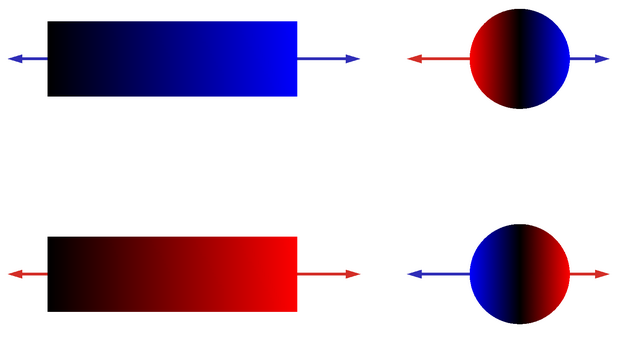
To the left is an electrified bar. On the right is a neutral sphere, but by its proximity to the electrified bar it becomes polarized, this means that there is a separation of charges:
if the bar is negatively charged, positive charges in the sphere will be attracted to its side and negative charges will be repelled to the opposite side.
if the bar is positively electrified, there is an inverse separation between the + and – charges of the sphere.
Attractive forces appear between the bar and the sphere, regardless of whether the bar is electrified + or -. The opposite charges of the bar and the sphere attract more strongly than charges of the same kind that are further apart repel each other. The sphere behaves as if it is electrified differently than the bar, even though it has equal amounts of + and – charges. Bringing the sphere closer to the bar did not put additional load on the sphere, it just redistributed the existing load.
Always in influence electrification only attractive forces appear and this explains why a charged object (+ or -) attracts small neutral objects.
All substances can be divided into:
Conductors (electrically conductive substances); This category includes all metals, carbon in the form of graphite, electrolytes (solutions containing positive and negative ions), ionized gases (plasma);
Insulators (electrically insulating substances); This category includes: plastics, glass, ceramics, chemically pure water, neutral (non-ionized) gases;
Semiconductors; It is an intermediate category of substances, which are neither conductors nor insulators, but by changing some conditions they can be easily influenced to become conductors or insulators temporarily.
All substances can be electrified (by contact, friction, influence), regardless of their type, but depending on their type (conductors or insulators) their behavior is different.
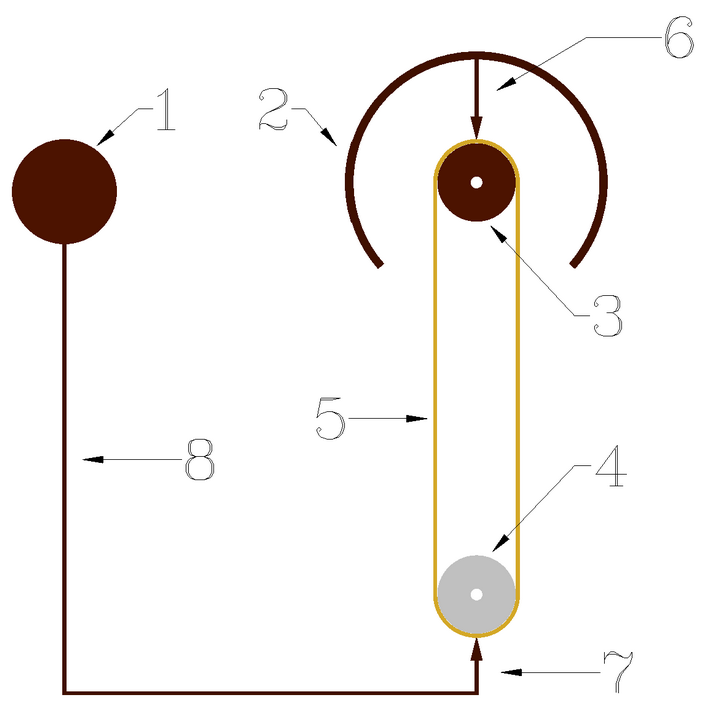
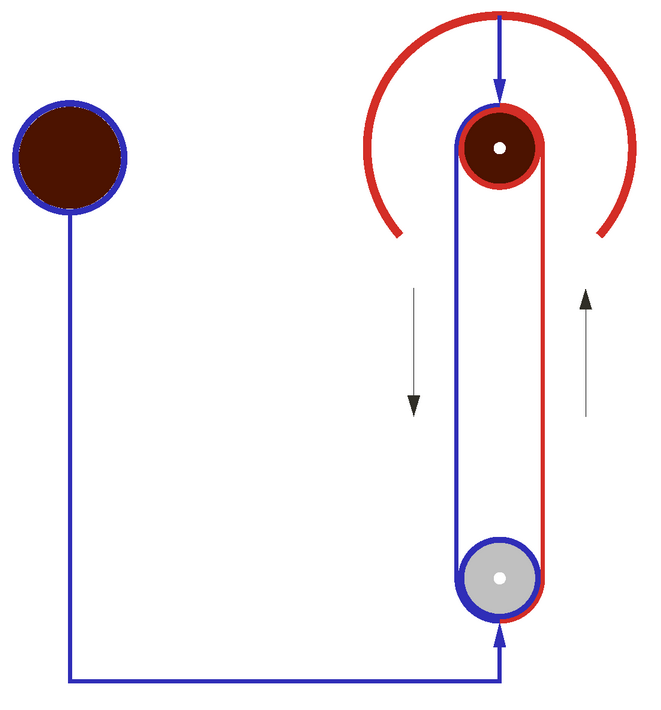
It separates the + and – charges generating static electricity by using all electrification methods. The main component parts are:
a metal sphere,
a spherical metal dome,
a metal top roller,
a lower plastic roller (preferably PTFE),
a natural rubber band,
an upper metal comb,
a lower metal comb,
electrical conductors.
At the beginning all components are electrically neutral. Set the tape in motion in the direction indicated. When the strip passes over the lower roll 4, the strip is charged + (gives up electrons), and the roll is charged – (receives electrons from the strip). On the upper roll (3) the situation is reversed: this roll gives up electrons and gets charged +. Thanks to these + charges, electrons are extracted from the spherical metal dome, which by means of the metal comb 6 are brought to the strip and transported to the lower part. Down there, the electrons will be directed by means of the comb 7 and the conductor 8 towards the sphere 1, which will thus be charged -.
This is a simple generator that produces static electricity by influence.
This is a generator that produces static electricity by influence.
Determine the amounts of charges + and – contained in the following substances with a mass of 1g: water, lithium, zinc, aluminum, lead, copper, iron, nickel.
Determine the amounts of charge – that could be obtained by complete +1 ionization of a 1g mass of the following metals: lithium, copper, silver.
Determine the amounts of charge – that could be obtained by complete +2 ionization of a 1g mass of the following metals: zinc, iron, copper.