|
|
|
|
|||
Electrokinetics studies electric current and its effects. Electric current is an orderly movement of electrical charges.
|
|
|
|
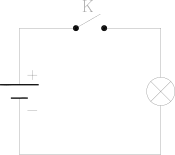
Simple circuit with a source, a light bulb and an open switch The bulb does not light up. |
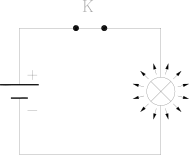
Simple circuit with a source, a light bulb and a closed switch The light bulb lights up. |
|
|
|
|
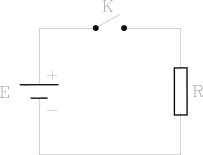
Simple, open circuit with a source and a consumer No current is flowing. |
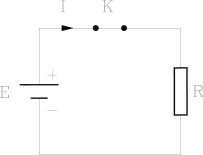
Simple, closed circuit Current flows. |
It circulates through the electrical circuit electric charge q:
|
|
|
|
Current intensity I shows how much electric charge passes per unit time through any section of the simple circuit:
|
|
|
|
The conventional direction of current through the circuit has been established to be the direction in which positive charges would flow: they are repelled by the + terminal of the voltage source and attracted by the – terminal of the source.
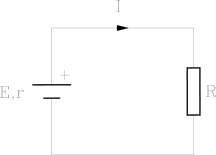
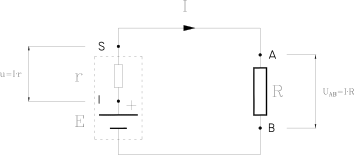
The determining factor of the flow of electric charge is electrical voltage. Without voltage, current does not flow. Voltage UAB between 2 points A, B along the circuit represents the mechanical work that the source must perform to force the passage of 1C of electric charge on the circuit portion AB:
|
|
|
|
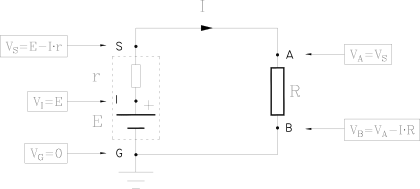
Electric potential represents the energy of the unit of electric charge relative to a reference point of the circuit.
Optionally, the - terminal of the voltage source can be connected to the Earth (earthing) or to the ground, at point G (ground), taken as a reference point. The electric charges reached at that point have no more energy and their electric potential at that point is 0:VG=0.
On the other hand, at the point S (at the + terminal) the electric charges have the maximum possible energy, and the electric potential is also maximum at the point S.
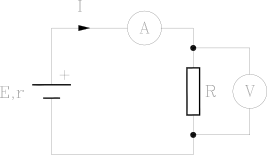
Current and voltage can be measured directly with measuring instruments: ammeter and voltmeter.
Electrical resistance shows how much a portion of the circuit (or a circuit element) resists the flow of current.
|
|
|
|
This law is stated in two versions:
The intensity of the current is directly proportional to the voltage:
|
|
|
|
UAB is the voltage drop on the circuit portion AB, and RAB is the electrical resistance of that portion.
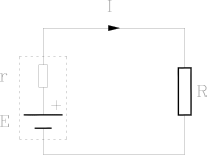
The electromotive voltage of the source is equal to the sum of the voltage drops throughout the circuit, including the voltage drop on the internal resistance of the source:
|
|
|
|
U is the voltage drop across all external elements of the circuit, and u is the voltage drop across the internal resistance.
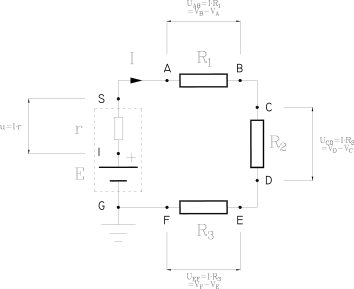
Simple circuit with several consumers
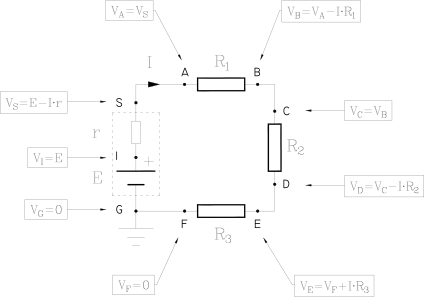
Electric potentials in an electric circuit